


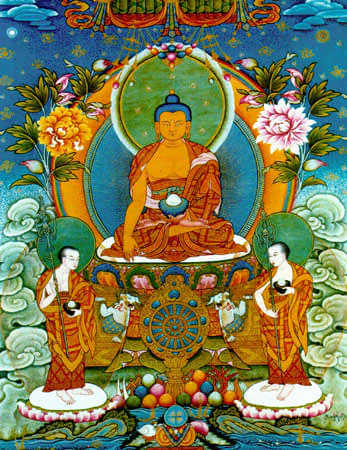
āṭa-aṇāṭiya-sūtra
The Sutra of the Adakavati Palace [Yaksha Anati]
With faith, I prostrate myself before the Three Noble Jewels!
Thus have I heard.
The Blessed One was staying at Rajagaha, on Mount Gridhrakuta. At that time, four great kings, together with retinues of numerous yakshas, retinues of gandharvas, retinues of kumbhandas, and countless retinues of nagas, were standing guard and remained at the four cardinal directions. Divided into separate regiments, they stood at all four directions, protecting and guarding each one.
When night fell, they illuminated the entire Mount Korshuna with the radiance of their bodies, which blazed with every conceivable hue. Proceeding to where the Blessed One was, they bowed respectfully and sat down nearby. Among these yakshas, some simply sat down nearby after bowing to the Blessed One. Some respectfully inquired of the Blessed One about his health and well-being, and after these questions—some serious, some trivial—they, too, sat down nearby. Others, joining their palms before the Blessed One, bowed and sat down nearby. A few of them began to state their names and lineages as they took their seats nearby, while others sat off to the side, remaining completely silent.
When they had all taken their seats nearby, the great king Vaiśravana addressed the Blessed One with these words:
Venerable Blessed One! Among the fierce and frenzied yakṣas, there are those who do not have faith in the Blessed One. But there are also, among the fierce yakṣas, those who have attained deep faith in the Blessed One. Likewise, among the middle-ranking yakṣas, there are those who do not believe in the Venerable Blessed One, and those who sincerely believe in the Venerable Blessed One. And among the lowest, ordinary yakṣas, there are those who lack faith in the Venerable Blessed One, and those who devoutly believe in the Venerable Blessed One.
Venerable Blessed One, what is the reason that so many yakṣas lack faith in the Blessed One? The reason is that the Venerable Blessed One teaches the holy Doctrine, which commands the complete renunciation of taking life; he teaches the Doctrine of the renunciation of stealing; he teaches the Doctrine of the renunciation of sexual misconduct; he teaches the Doctrine of the renunciation of false speech; and he teaches the Doctrine of the complete renunciation of intoxicating wine. Most yakṣas, however, take pleasure in killing and find the renunciation of taking life extremely distasteful; they do not like to abstain from stealing, do not wish to abstain from sexual misconduct, cannot bear to abstain from false speech, and feel a deep aversion to the law prohibiting the drinking of intoxicating wine; therefore, all these rules are unwelcome to them and deeply hated.
Meanwhile, the numerous śrāvaka disciples of the Venerable Blessed One set out for distant forest wildernesses, seclude themselves in deserted places, and spend their time in sleep and contemplation. They dwell in the wilderness, where there is no noise or the clamor of voices, far from the worldly crowds and worldly afflictions. There, these sramanas live peacefully in harmony with one another. But it is precisely in these wild forests that the secret lairs of the ferocious and frenzied yakshas are spread out!
So that those among them who still lack faith in the Blessed One’s sacred teachings may find devotion, the Venerable Blessed One should impart protective instruction to them. I beseech you to bestow upon them this protection of the great palace of Alakavati! May it serve as reliable armor, a refuge, and deliverance from all afflictions, bringing peace and well-being to the monks, nuns, lay male disciples, and lay female disciples.
And the Blessed One gave his consent, maintaining complete, noble silence.
Then the great king Vaisravana, realizing that the Blessed One had given his consent, recited this protective prayer for the Alakavati Palace:
I reverently pay homage to the All-Seeing One, endowed with the great eye and majesty [Buddha Vipashyin]! I pay homage to Ushnishin [Buddha Shikhin], whose heart is filled with great love for all living beings! I pay homage to the Universal Protector [Buddha Veshrabh], who has compassion for all the unfortunate and the destitute! I pay homage to the Conqueror of Mara’s hordes, who has shattered the chains of the cycle of samsara [Buddha Krakuchchanda]! I pay homage to the great Brahmin, the Golden Sage, endowed with pure majesty [Buddha Kanakamuni]! I pay homage to the Guardian of Light [Buddha Kashyapa], who grants living beings complete liberation! I pay homage to the great son of the Shakya clan, endowed with glory, born into the radiant solar dynasty [Buddha Shakyamuni]! He is the one who delivers all beings from suffering without exception and superbly reveals the holy Teaching to the world! All the Buddhas who have appeared in this earthly world have seen all things exactly as they truly are! There is not the slightest impurity or falsehood in them, and they abide in great, unshakable equanimity.
Whoever pays reverent homage to Gautama, the source of goodness for gods and humans, draws near to the one endowed with supreme wisdom and impeccable conduct, to the great guardian of Fearlessness!
Where, beyond the boundless horizons, the majestic sun disk sets and rises anew—in that direction, where the sun hides behind the edge of the earth—a pitch-black night descends. And in that region where the sun rises over the world—a time called the bright day—there stretch the deep, bottomless waters of the great ocean, and the waters there are pure and bountiful. All beings born in that region are likened to the purity and strength of these boundless ocean waters. And therefore, regarding the eastern side of the earthly world, living beings are instructed as follows: this part of the world is fully protected by a great king, endowed with immense, boundless glory. He is the supreme lord of all the Gandharvas, and his name is King Dhritarashtra. Together with his vast retinue of gandharvas, he abides ceaselessly in pure joy, delighting in sacred chants and dances. This king has a great multitude of sons, whose names resonate with the single concept of Indra. There are exactly ninety-one brothers in all, and they are all endowed with overwhelming power. And even they, as soon as they catch sight of the Buddha—that great kinsman of the sun, that great guardian of fearlessness—bow in deep, reverent homage even from afar!
O all-knowing one, we bow to you! O most exalted one, we bow to you! To you, who ceaselessly speak of goodness, all non-human beings bow with reverence. They eternally heed your words. And therefore, proclaiming this, we call out: Let us pay reverent homage to the Victorious Gautama! We pay homage to the Victorious Gautama. We pay homage to the Buddha Gautama, endowed with supreme wisdom and impeccable conduct!
[These protective verses also subdue] those hungry ghosts who fill the world with their cries, plot secret slander behind others’ backs, are obsessed with taking the lives of others, and cruelly oppress all living beings without exception.
To the living beings of the southern region of the earthly world, the following is commanded. This abode is fully protected by the great king, endowed with boundless glory. He is the supreme ruler of all the kumbhandas, and his name is King Virudhaka.
Together with his entire retinue of kumbhandas, he abides ceaselessly in pure joy, delighting in sacred chants and dances. This king has a great multitude of sons, whose names are synonymous with the single concept of Indra. There are exactly ninety-one brothers in all, and they are all endowed with overwhelming power. And even they, as soon as they catch sight of the Buddha, the great successor of the solar dynasty, rush toward this great guardian of Fearlessness and, even from afar, bow before him in a deep, reverent prostration.
O all-knowing one, we bow to you! O most exalted one, we bow to you! To you, who ceaselessly speak of goodness, all non-human beings bow with reverence. They eternally heed your words. And therefore, proclaiming this, we call out: Let us pay reverent homage to the Victorious Gautama! We pay homage to the Victorious Gautama. We pay homage to the Buddha Gautama, endowed with supreme knowledge and impeccable conduct!
There, beyond the boundless horizons, where the majestic sun disk rises and sets, a clear day dawns, and that time is called the bright day. And in that region where the sun disappears from view, the time is called “dark night.” There stretch the deep, bottomless waters of the great ocean, and the essence of those waters is pure and bountiful. All beings born in that region are likened to the purity and strength of these boundless ocean waters.
Regarding the western side of the earthly world, living beings are instructed as follows: This side of the world is fully protected by a great king, endowed with immense, boundless glory. He is the supreme ruler of all the nagas, and this king’s name is Virupaksha. Together with his vast retinue of nagas, he abides ceaselessly in pure joy, delighting in songs and dances. This king has a great multitude of sons, whose names are synonymous with the single concept of Indra. There are exactly ninety-one brothers in all, and they are all endowed with overwhelming power. And even they, as soon as they catch sight of the Buddha, the great solar kinsman, rush toward this great guardian of Fearlessness and, even from afar, bow before him in a deep, respectful prostration.
O all-knowing one, we bow to you! O most exalted one, we bow to you! To you, who ceaselessly speak of goodness, all non-human beings bow with reverence. They eternally heed your words. And therefore, proclaiming this, we call out: Let us pay reverent homage to the Victorious Gautama! We pay homage to the Victorious Gautama. We pay homage to Gautama Buddha, endowed with supreme wisdom and impeccable conduct!
To the north lies the [continent] of Uttarakuru. To behold its sacred mountain, Meru, is a great delight and joy. People born in that blessed land are free from any sense of selfish possessiveness. They never sow seeds in the ground nor engage in plowing. Without any labor or arduous asceticism, food ripens there of its own accord, and people fully savor these gifts. There ripens the purest, most exquisite rice, free from husks, chaff, and bran, and endowed with a wondrous aroma. People cook it in the purest coconut or milk juice, and, having cooked it to perfection, they share this meal carefree. They ride on marvelous one-horned cows (or bulls) and travel on them to all towns and directions. Riding these wondrous domestic animals, they effortlessly visit any lands and regions. They travel to various places, using [wondrous illusory] women as mounts, using men as mounts, traveling by sitting on young maidens, and riding everywhere on the backs of handsome young men. Riding these various modes of transportation, they move carefree in all directions. And in this, great lords and ordinary kings are no different from one another. They ride on enormous elephants, magnificent horses, and divine modes of transportation. Moving through the soaring celestial halls and on luxurious litters, the great king, endowed with boundless glory [Vaiśravana], reveals himself. All his numerous sacred cities, created by the power of the siddhas, rest unshakably right in the pure air. These are the magnificent city of Alakavati, the cities of Kush, the great cities of Parakush on that shore, the celestial cities of Nata, and the expanses of the cities of Kushita stretching beyond them.
In the northern region, everything is in full bloom and abundance. There dwell vast, dense multitudes of living beings. Ninety-nine of these majestic cities soar high in the heavens, and towering above them all is the main royal residence, the palace of Alakavati. In addition, the great rishis and the Great King himself, known as Kubera, possess a magnificent palace named Vishana. And it is for this very reason that this great king is honored as the son of Vaiśravaṇa [the All-Hearing] and Kubera [the One with an Unusual Form].
Each of these rulers, individually, is radiant, serene, and endowed with a unique, inimitable complexion and dazzling grandeur. He is courageous and imbued with overwhelming power, and such are the names of these mighty kings. The very earth in that land is filled with the purest sap and fertility. And the clouds above that realm pour down bountiful rains. There lies a wondrous pond named Bhagala-vati, beside which great hosts of yakshas dwell constantly. Fruits ripen eternally on the branches of the trees there, and flocks of all manner of birds live carefree upon them. Peacocks and cranes fill the skies with their sweet voices, and cuckoos sing there, gathered in noisy flocks. Pheasants utter wondrous cries, followed by the songs of mallards and wood grouse that inhabit the shores of these forest ponds. Parrots and thrushes call to one another, and white Danatamita herons adorn this region with their beauty throughout all seasons. King Kubera’s magnificent pond is endowed with timeless grace.
Concerning the northern side of the earthly world, people are instructed as follows: This side of the world is fully protected by the great king, endowed with boundless glory. He is the supreme ruler of all yakshas, and this king’s name is Kubera. Together with his entire retinue of yakshas, he abides ceaselessly in pure joy, delighting in songs and dances. This king has a great multitude of sons, whose names are synonymous with the single concept of Indra. There are exactly ninety-one brothers in all, and they are all endowed with overwhelming power. And even they, as soon as they catch sight of the Buddha, the great one of the solar dynasty, rush toward this great guardian of fearlessness and, even from a distance, bow before him in a deep, respectful prostration.
O all-knowing one, we bow to you! O most exalted one, we bow to you! To you, who ceaselessly speak of goodness, all non-human beings bow with reverence. They eternally heed your words. And therefore, proclaiming this, we call out: Let us pay reverent homage to the Victorious Gautama! We pay homage to the Victorious Gautama. We pay homage to the Buddha Gautama, endowed with supreme wisdom and impeccable conduct!
Therefore, may the great rishis protect the monks with this protection of the great Alakavati Palace! May it serve as reliable armor, a refuge, and deliverance from all afflictions, bringing peace and well-being to the monks, nuns, lay male disciples, and lay female disciples.
O great rishis! Whoever is in the company of monks, nuns, laymen, or laywomen, firmly imprint this protection of the Alakavati Palace in your minds, so that it may safeguard them in its entirety! For these malevolent non-human beings—whether a male or female yakṣa, a son or daughter of a yakṣa, a great minister of the yakṣas, a commoner among the yakṣas, or their slave and servant; a male or female celestial musician-gandharva, a son or daughter of a gandharva, a great minister of the gandharvas, their kinsman or servant; a male or female kumbhanda, his son or daughter, a great minister of the kumbhandas, their kinsman or servant, a male or female serpent-like naga, a son or daughter of a naga, the great minister of the Nags, their kinsman or servant—who, with fierce hatred in their hearts, will pursue them, follow in their footsteps, stand beside them, live in the same dwelling, or lie down to sleep next to them! Know, O great Rishis, that such beings have defiled the title of non-humans!
If such treacherous non-humans run amok, they forfeit the right to receive honor, respect, and offerings in cities and villages. May they never find support or refuge in the royal palace of Alakavati!
O great rishis, such non-humans will no longer be permitted to live and feast alongside the righteous yakshas. O great rishis, from now on, all other non-humans will despise them and refuse to heed their commands. O great rishis, moreover, the other non-humans will shower such outcasts with curses and subject them to severe abuse during disputes. O great rishis, other spirits will forcibly place iron vessels, white-hot and blazing with fire, upon their heads. O great rishis, for such outrages, the heads of these evil non-humans will split into exactly seven pieces! O great rishis, for these vile subhumans are by nature ferocious, frenzied, and wrathful. When such oppression occurs, people must immediately cry out and report what has happened to the great king [Vaiśravaṇa]. If, however, they are unable to reach the great king himself, they should report it to his ministers and envoys. If they cannot inform the royal envoys, they must report it to the lower-ranking guards and servants. For, O great rishis, such evil monsters, through their misdeeds, go against the commands of the great king himself.
O great rishis, this is analogous to the following. If bandits and thieves appear in the kingdom of Magadha, the inhabitants immediately report this to the king of Magadha himself. If they cannot inform the king himself, they report it to the king’s envoys. And if they cannot inform the envoys, they report it to the lower-ranking guards. O great rishis, they then proclaim loudly that the bandits are committing lawlessness and causing harm to the king of Magadha. In exactly the same way, O great rishis, as long as these ferocious, frenzied, and wrathful monsters exist, whenever they attack, the great kings of the four quarters of the world must be notified immediately. If it is impossible to inform the great kings themselves, one must report to their envoys. And if it is not possible to inform the envoys, one should announce it to their subordinate servants and guards. O great rishis, for such non-human beings, through their attacks, violate the direct decree of the great kings. Therefore, O great rishis, if any wicked non-human—be it a yakṣa or yakṣī, the son or daughter of a yakṣa, his great minister, kinsman, or servant; a male or female gandharva, his son or daughter, minister, kinsman, or servant; a male or female kumbhanda, his son or daughter, minister, kinsman, or servant; a male or female naga, his son or daughter, the great minister of the nagas, his kinsman or servant; with fierce hatred in his heart dares to pursue a monk, a nun, a layman, or a laywoman-novice; to follow in their footsteps, stand near them, live under the same roof as them, or lie down to sleep beside them—then Buddhists should immediately appeal to the good and righteous yakṣas, to the great lords of the yakṣas, to the celestial commanders, and to the great military leaders. They must shout loudly, raise a frenzied commotion, and proclaim for all to hear: “This yakṣa has seized us! This yakṣa is stealing our life force! This yakṣa is cruelly oppressing us! This yakṣa is mocking and taunting us! This yakṣa is inflicting grave harm upon us! This yakṣa is causing us unbearable harm and flatly refuses to set us free!”
Who, then, are these benevolent yakshas, great yakshas, military commanders, and great military commanders? They are: Indra, Soma, Varuna, Prajapati, Chandana, Kamareshtha, Sugula, Vigula, Prajapati the Mentor, and the divine charioteer Matali; the gandharva Panchashikha with his troops; King Nara; the leaders of the victorious herds; as well as the [spirits] of the mountains and the Snowy Ranges; the yakshas Purana, Kartikeya, and Phuga; Jiva, Ajakabaka, various spiritual friends and Yugandhara, Bhumi-pala with his great knowledge, Ucchaykshravas with his eyes and palaces, Panchala, the fierce Alavaka, the righteous Siddhartha, the spirit of Good Thought, Sumukha, Dadhimukha, Mani, Manichara, as well as the supreme lord Ishvara. It is to these benevolent yakshas, these great yakshas, these commanders, and these great commanders that one must call out, raising a frenzied clamor and proclaiming for all to hear: “Here a yaksh has seized us! This yakṣa is stealing our life force! This yakṣa is oppressing us! This yakṣa is mocking us! This yakṣa is inflicting harm upon us! This yakṣa is causing us harm and flatly refuses to set us free.”
O great rishis, may this protection of the great palace of Alakavati steadfastly safeguard the practitioners! May it serve as reliable armor, a refuge, and deliverance from all oppression, bringing peace and well-being to the monks, nuns, lay male disciples, and lay female disciples. O great rishis, it is now time for us to depart. We are beings burdened by a great multitude of tasks and worldly duties.
And the Blessed One said:
O great kings, you may now depart!
And then the four great kings rose from their seats, respectfully bowed to the Blessed One, circled him three times, and miraculously vanished into thin air right there on the spot. The remaining yakṣas also rose, bowed to the Blessed One, performed the ritual circumambulation, and vanished into thin air. Those among them who had respectfully inquired after his well-being and conversed on matters both important and trivial also vanished instantly. Those who simply stood with their palms pressed together before the Blessed One dissolved into thin air at that very moment. Those who had stated their names and lineages also instantly disappeared from view. And those who sat in complete silence also vanished into thin air.
Thus ends the first, sublime chapter of the *Sutra on the Palace of Alakavati*.
Then, when that night had passed [and morning came], the Blessed One summoned the monks and addressed them with these words:
O monks! Last night, the four great kings, together with the vast armies of the yakṣa commanders under their command, numerous detachments of gandharvas, immense hordes of kumbhandas, and a great multitude of nāgas, stood guard and remained at the four cardinal directions. Divided into separate regiments, they stood at all four cardinal directions. When night fell, they illuminated the entire Mount Gridhrakuta with the radiance of their bodies, which blazed with every conceivable hue. Proceeding to where I was, they bowed respectfully and sat down nearby. O monks, some of these yakshas, after bowing, simply sat down beside me. Some respectfully inquired about my health and well-being, and after asking about matters both important and trivial, they too sat down beside me. Others, joining their palms before me, performed a silent bow and sat down beside me. A few of them began to state their names and lineages as they sat down beside me, while others sat off to the side, remaining completely silent. When they had all settled down beside me, O monks, the great king Vaiśravana addressed me with these words:
Among the fierce and frenzied yakṣas, there are those who do not have faith in the Venerable Blessed One. But there are also, among the fierce yakṣas, those who have attained deep faith in the Blessed One. Likewise, among the middle-ranking yakṣas, there are those who do not believe in the Venerable Blessed One, and those who sincerely believe in the Venerable Blessed One. And among the lowest, ordinary yakṣas, there are those who lack faith in the Venerable Blessed One, and those who devoutly believe in the Venerable Blessed One.
Venerable Blessed One, what is the reason that so many yakṣas lack faith in the Blessed One? The reason is that the Venerable Blessed One preaches the Holy Teaching, which commands the complete renunciation of taking another’s life, preaches the Teaching of abstaining from stealing, preaches the Teaching of abstaining from sexual misconduct, preaches the Teaching of abstaining from false speech, and preaches the law of complete abstinence from intoxicating wine. Most yakṣas, however, take pleasure in killing and find the renunciation of taking life extremely distasteful; they feel deep aversion toward the precepts against stealing, against sexual misconduct, against false speech, and against the consumption of intoxicating wine. Therefore, all these precepts are unwelcome to them and deeply hated.
Venerable Blessed One, the Venerable Blessed One’s numerous śrāvakas set out for distant forest wildernesses, retreating to desolate places where they spend their time in sleep and contemplation. They dwell in remote areas where there is no noise or the clamor of voices, far from the worldly crowds and worldly afflictions. There, these ascetics live peacefully in harmony with one another. But it is precisely in these wild forests that the secret abodes of the ferocious and frenzied yakshas are spread out!
So that those among them who still lack faith in the Blessed One’s sacred words may find devotion, the Venerable Blessed One ought to impart to them protective instruction. I ask you to impart to them this protection of the great palace of Alakavati! May it serve as reliable armor, a refuge, and deliverance from all forms of oppression, bringing peace and prosperity to the monks, nuns, lay male disciples, and lay female disciples.
And I, O monks, expressed My consent, maintaining complete, noble silence. Then the great king Vaisravana, realizing that I had given My consent, recited this protective prayer for the great palace of Alakavati:
I pay homage to the All-Seeing One, who possesses glory and the eye! I pay homage to the One with the Ushnisha, whose heart is filled with great love for all living beings! I pay homage to the Protector of all, who has compassion for all the unfortunate and the destitute! I pay homage to the Conqueror of Mara’s hordes, who has shattered the chains of the cycle of samsara! I pay homage to the great Brahmin, the Golden Sage, endowed with pure majesty! I pay homage to the Guardian of Light, who grants living beings complete liberation! I pay homage to the great son of the Shakya clan, endowed with glory, born into the radiant solar dynasty!
He is the one who delivers all beings from suffering without exception and supremely reveals the holy Teaching to the world! All Buddhas who have appeared in this earthly world have seen all things exactly as they truly are. There is not the slightest trace of defilement or falsehood in them, and they abide in great, unshakable equanimity. Whoever offers a reverent bow to Gautama, the source of goodness for gods and humans alike, draws near to the one endowed with supreme wisdom and impeccable conduct—the great guardian of fearlessness!
There, beyond the boundless horizons, where the majestic sun disk sets and rises, in that region where the sun hides behind the edge of the earth, deep night falls. And in that realm where the sun rises over the world, the time is called bright day. There stretch the deep, bottomless waters of the great ocean, and the essence of those waters is pure and bountiful. All beings born in that region are likened to the purity and strength of these boundless ocean waters. And therefore, regarding the eastern side of the earthly world, living beings are instructed as follows: This side of the world is fully protected by the great king, endowed with immense, boundless glory. He is the supreme lord of all the Gandharvas, and his name is King Dhritarashtra. Together with his vast retinue of Gandharvas, he abides ceaselessly in pure joy, delighting in songs and dances. This king has a great multitude of sons, whose names are synonymous with the single concept of Indra. There are exactly ninety-one brothers in all, and they are all endowed with overwhelming power. And even they, as soon as they catch sight of the Buddha, the great Solar Kin, rush toward this great guardian of fearlessness and, even from a distance, bow before him in a deep, respectful prostration.
O all-knowing one, we bow to you! O most exalted one, we bow to you! To you, who ceaselessly speak of goodness, all non-human beings bow with reverence. They eternally heed your words. And therefore, proclaiming this, we call out: Let us pay reverent homage to the Victorious Gautama! We pay homage to the Victorious Gautama. We pay homage to the Buddha Gautama, endowed with supreme wisdom and impeccable conduct!
[These protective verses subdue] even those hungry ghosts who fill the world with their cries, plot secret slander behind others’ backs, are obsessed with taking the lives of others, and cruelly oppress all living beings without exception.
To the living beings of the southern region of the earthly world, the following is decreed: This realm is fully protected by the great king, endowed with boundless glory. He is the supreme ruler of all the kumbhandas, and his name is King Virudhaka. Together with his entire retinue of kumbhandas, he abides ceaselessly in pure joy, delighting in songs and dances. This king has a great multitude of sons, whose names are synonymous with the single concept of Indra. There are exactly ninety-one brothers in all, and they are all endowed with overwhelming power. And even they, as soon as they catch sight of the Buddha, the great successor of the solar dynasty, rush toward this great guardian of fearlessness and, even from a distance, bow before him in a deep, respectful prostration.
O all-knowing one, we bow to you! O most exalted one, we bow to you! To you, who ceaselessly speak of goodness, all non-human beings bow with reverence. They eternally heed your words. And therefore, proclaiming this, we call out: Let us pay reverent homage to the Victorious Gautama! We pay homage to the Victorious Gautama. We pay homage to Gautama Buddha, endowed with supreme wisdom and impeccable conduct!
Where, beyond the boundless horizons, the majestic sun rises and sets, a clear day dawns in that direction, and that time is called “daylight.” And on that side, where the sun disappears from view, the time is called “dark night.” There stretch the deep, bottomless waters of the great ocean, and the waters are pure and bountiful. All beings born in that region are likened to the purity and strength of these boundless ocean waters. Regarding the western side of the earthly world, living beings are commanded as follows: This side of the world is fully protected by a great king, endowed with immense, boundless glory. He is the supreme lord of all the nagas, and the name of this king is Virupaksha. Together with his entire vast retinue of nagas, he abides ceaselessly in pure joy, delighting in songs and dances. This king has a great multitude of sons, whose names are synonymous with the single concept of Indra. There are exactly ninety-one brothers in all, and they are all endowed with overwhelming power. And even they, as soon as they catch sight of the Enlightened Buddha, the great solar kinsman, rush toward this great guardian of fearlessness and, even from afar, bow before him in a deep, respectful prostration.
O all-knowing one, we bow to you! O most exalted one, we bow to you! To you, who ceaselessly speak of goodness, all non-human beings bow with reverence. They eternally heed your words. And therefore, proclaiming this, we call upon you: let us pay reverent homage to the Victorious Gautama! We pay homage to the Victorious Gautama. We pay homage to the Buddha Gautama, endowed with supreme wisdom and impeccable conduct!
To the north lies the continent of Uttarakuru. Beholding the sight of its sacred Mount Sumeru is a great delight and joy. People born in that blessed land are free from any sense of selfish possessiveness. They never sow seeds in the ground nor engage in plowing. Without any labor or arduous asceticism, food ripens there of its own accord, and the people fully savor these gifts. There ripens the purest, most exquisite rice, free from husks, chaff, and dust, and endowed with a wondrous aroma. People cook it in the purest coconut or milk juice, and, having cooked it to perfection, share this meal carefree. They ride on marvelous one-horned cows (or bulls) and travel on them to all towns and regions. Riding these marvelous domestic animals, they effortlessly visit any lands and regions. They travel to various places, using women as mounts, using men as mounts, traveling by riding young maidens, and riding everywhere on the backs of handsome young men. Riding these diverse modes of transportation, they move carefree in all directions. And in this, great lords and ordinary kings are no different from one another. They ride on enormous elephants, magnificent horses, and divine modes of transportation. Moving through the soaring celestial halls and on luxurious litters, the great king, endowed with boundless glory [Vaiśravana], reveals himself. All his numerous sacred cities, created by the power of the siddhas, rest unshakably right in the pure air. These are the magnificent city of Alakavati, the cities of Kush, the great cities of Parakush on that shore, the celestial cities of Nata, and the expanses of the cities of Kushita stretching beyond them. In the northern region, everything is in full bloom and abundance. There dwell vast, dense multitudes of living beings. Ninety-nine of these majestic cities soar high in the heavens, and towering above them all is the main royal residence, the palace of Alakavati. In addition, the great rishis (seers) and the Great King himself, known as the Ugly-Bodied One [Kuber], possess a magnificent palace, endowed with every virtue, named Alaka. And it is for this very reason that this great king is revered as the son of Vaishravana and Kuber. Each of these rulers, individually, is radiant, serene, and endowed with a unique, distinctive complexion and dazzling grandeur. He is courageous and filled with overwhelming power, and such are the names of these mighty kings. The very earth in that land is filled with the purest juices and fertility. And the clouds above that abode pour down bountiful rains. There lies a wondrous pond named Bhagala-vati, beside which great hosts of yakshas dwell constantly. On the branches of the trees there, fruits ripen eternally, and flocks of all manner of birds live there carefree. Peacocks and cranes fill the skies with their sweet voices, and cuckoos sing there, gathered in noisy flocks. Pheasants utter wondrous cries, followed by the songs of mallards and wood grouse that inhabit the shores of these forest ponds. Parrots and thrushes call to one another, and the white Danatamina herons adorn this land with their beauty throughout all seasons. King Kubera’s magnificent pond is endowed with timeless grace.
Regarding the northern region of the earthly world, people have been instructed as follows: This part of the world is fully protected by a great king endowed with boundless glory. He is the supreme ruler of all yakshas, and this king’s name is Kubera. Together with his entire retinue of yakshas, he dwells ceaselessly in pure joy, delighting in songs and dances. This king has a great multitude of sons, whose names are synonymous with the single concept of Indra. There are exactly ninety-one brothers in all. And even they, as soon as they catch sight of the Buddha, the great solar kinsman, rush toward this great guardian of fearlessness and, even from a distance, bow before him in a deep, reverent prostration.
O all-knowing one, we bow to you! O most exalted one, we bow to you! To you, who ceaselessly speak of goodness, all non-human beings bow with reverence. They eternally heed your words. And therefore, proclaiming this, we call out: Let us pay reverent homage to the Victorious Gautama! We pay homage to the Victorious Gautama. We pay homage to the Buddha Gautama, endowed with supreme wisdom and impeccable conduct!
Therefore, may the great rishis protect the monks with this protection of the great Alakavati Palace! May it serve as reliable armor, a refuge, and deliverance from all afflictions, bringing peace and well-being to the monks, nuns, lay male disciples, and lay female disciples.
O great rishis! Whoever may be in the presence of monks, nuns, laymen, or laywomen, firmly imprint this protection of the Alakavati Palace in your minds, so that it may safeguard them in every respect. For these harmful non-humans—whether a male or female yakṣa, a son or daughter of a yakṣa, a chief minister of the yakṣas, a commoner among the yakṣas, or their servant; a male or female celestial musician-gandharva, a son or daughter of a gandharva, a chief minister of the gandharvas, their kinsman, or their servant; a male or female kumbhanda, his son or daughter, a great minister of the kumbhandas, a fellow kumbhanda, or their servant; a male or female serpent-like naga, a son or daughter of a naga, the great minister of the Nags, their kinsman or servant—who, with fierce hatred in their hearts, will pursue them, follow in their footsteps, stand beside them, live in the same dwelling, or lie down to sleep next to them—know, O great Rishis, that such beings have defiled the title of non-human beings.
If such treacherous non-humans run amok, they are deprived of the right to receive honor, respect, and offerings in cities and villages. They shall never find support or refuge in the royal palace of Alakavati. O great rishis, such non-humans will no longer be permitted to live and feast together with the righteous yakshas. O great rishis, from now on, all other non-humans will despise them and refuse to heed their commands. O great rishis, moreover, the other non-humans will shower such outcasts with curses and subject them to severe abuse during disputes. O great rishis, others will forcibly place red-hot, flaming iron vessels upon their heads. O great rishis, for such atrocities, the heads of these evil non-humans will split into exactly seven pieces! O great rishis, for these vile non-humans are, by their very nature, ferocious, frenzied, and wrathful.
When such oppression occurs, people must immediately cry out and report what has happened to the great king. If, however, they are unable to reach the great king himself, they should report it to his ministers and envoys. If they cannot inform the royal envoys, then they must report it to the lower-ranking guards and servants. For, O great rishis, such wicked monsters, through their misdeeds, defy the commands of the great king himself.
O great rishis, this is like the following: if bandits and thieves appear in the kingdom of Magadha, the inhabitants immediately report this to the King of Magadha himself. If they cannot inform the king himself, they report it to the royal envoys. And if they cannot inform the envoys, they report it to the lower-ranking guards. O great rishis, they then proclaim loudly that the bandits are committing lawlessness and causing harm to the king of Magadha. In the same way, O great rishis, as long as these ferocious, frenzied, and wrathful monsters exist, whenever they attack, the great kings of the four quarters of the world must be notified without delay. If it is impossible to inform the great kings themselves, one must report to their envoys. And if it is not possible to inform the envoys, one should announce it to their subordinate servants and guards. O great rishis, for such non-human beings, through their attacks, violate the direct decree of the great kings.
Therefore, O great rishis, if any wicked non-human—be it a yakṣa or a yakṣī, the son or daughter of a yakṣa, his chief minister, kinsman, or servant; a male or female gandharva, his son or daughter, minister, kinsman, or servant; a male or female kumbhanda, his son or daughter, minister, kinsman, or servant; a male or female naga, his son or daughter, the great minister of the nagas, his kinsman, or servant—should, with fierce hatred in his heart, dare to pursue a monk, a nun, a layman or a laywoman-novice, follow in their footsteps, stand near them, live under the same roof with them, or lie down to sleep beside them—then Buddhists must immediately appeal to the good and righteous yakṣas, to the great lords of the yakṣas, to the celestial commanders, and to the great warlords!
They must shout loudly, raise a frenzied commotion, and proclaim for all to hear: “A yakṣa has seized us here! This yakṣa is stealing our life force! This yakṣa is oppressing us! This yakṣa is mocking us! This yakṣa is harming us! This yakṣa is harming us and flatly refuses to set us free!”
Who, then, are these benevolent yakṣas, these great yakṣas, these commanders, and these great spiritual commanders? They are: Indra, Soma, Varuna, Prajāpati, Chandan, Kamareshtha, Sugula, Vigula, Prajapati the Mentor, and the divine charioteer Matali; the gandharva Panchashikha with his troops; King Nara; the leaders of the victorious herds; as well as the yakshas Purana, Kartikeya, and Phuga, who dwell in the mountains and the Snowy Ranges; Jiva, Ajakabaka, various spiritual friends and Yogandhara, Bhumipala with his great knowledge, Ucchaykshravas with his eyes and palaces, Panchala, the fierce Alavaka, the righteous Siddhartha, the spirit of Good Thought, Sumukha, Dadhimukha, Mani, Manichara, as well as the supreme lord Ishvara.
It is to these benevolent yakshas, these great yakshas, these commanders, and these great commanders of the spirits that one must call out, raising a frenzied clamor and proclaiming for all to hear: “Here a yaksh has seized us! This yakṣa is stealing our life force! This yakṣa is oppressing us! This yakṣa is mocking us! This yakṣa is inflicting harm upon us! This yakṣa is causing us harm and flatly refuses to set us free!”
O great rishis, may this protection of the great palace of Alakavati steadfastly safeguard [the practitioners]! May it serve as reliable armor, a refuge, and deliverance from all oppression, bringing peace and well-being to the monks, nuns, lay male disciples, and lay female disciples. O great rishis, it is now time for us to depart. We are beings burdened by a great multitude of tasks and worldly duties.
And I, O monks, then granted the great kings permission to depart. And then the four great kings rose from their seats, respectfully bowed to me, circumambulated me three times, and miraculously vanished into thin air right there on the spot. The rest of the yakṣas also rose, bowed to me, performed the ritual circumambulation, and vanished into thin air. Those among them who respectfully inquired after my well-being and conversed on matters both important and trivial also vanished instantly. Those who simply stood with their palms pressed together before me, expressing their reverence, vanished into thin air at that very moment. Those who had stated their names and lineages also instantly disappeared from view. And those who sat in complete silence likewise vanished into thin air.
O monks! Firmly imprint this protection of the Alakavati Palace in your memory as a daily practice! O monks, uphold it ceaselessly! O monks, uphold it along with its full and profound meaning! And may it serve as reliable armor, a refuge, and deliverance from all afflictions, bringing peace and well-being to the monks, nuns, lay male disciples, and lay female disciples.
When the Blessed One had spoken these words, those monks extolled what
the Blessed One had said. With this, the second chapter of the “Sutra on the Palace of Alakavati” comes to an end, and the entire sutra is now complete.
[This sutra] was translated, collated, and definitively authenticated from the words of the great pandita Anandashri by the erudite lotsa, the Shakya monk Nyima Gyaltsen Palzanpo, at the great monastery of Pal Tharpa Ling, the residence of those who speak in two languages. May it shine upon the earth like the Sun and the Moon!
Translated by Lama Dondrub Dorje Tulku.