


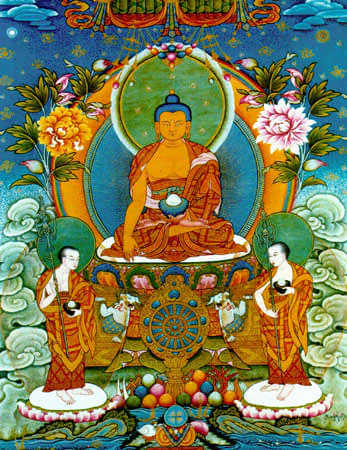
maitrī-sūtra
The Maitreya Sutra
I respectfully prostrate myself before the Three Jewels of the Noble Ones!
The Teacher was once staying in the land of Kapilavastu, in the Nyagrodha Grove, on the banks of the Rohini River. At that time, the Venerable Shariputra, for the sake of the future Victor, asked the Blessed One:
What will Your successor, established in wisdom, be like? What kind of Buddha will he become? I wish to listen deeply and attentively to the All-Seeing One who has attained perfect fulfillment!
Having heard the elder’s question, the Blessed One spoke these words: “It is impossible to enumerate completely all the virtues of the text [concerning the one endowed with] a considerable accumulation of merit, great glory, and the name ‘The Invincible.’ However, by briefly expounding this auspicious teaching, I shall reveal to you only one aspect of it.
Shariputra, listen carefully to my words! In this Auspicious Age, after millions of years, a Buddha—the supreme among bipeds—will appear under the very name of Maitreya.
After I have passed away [into parinirvana], five periods [of the Teaching’s decline] will first occur: the time of the fruit; the time of fulfillment [of practice]; the time of the texts; the time of mere symbols; and the time of the bodily relics.
As for the time of the fruit, for one thousand years after the Buddha’s complete entry into nirvana, people will be capable of giving rise to true realization within themselves. This time will gradually come to an end. [As long as] those who have attained the fruit of non-return, once-returner, and stream-enterer are still alive, it cannot be said that the time of the fruit has disappeared. When the last of those who have entered the stream passes away, this will be called the concealment of the time of the fruit. This is what is referred to as the completion of the attainment of the fruit.
What is called the time of fulfillment [of the practice] is the period when people are no longer capable of learning the fruits of the path of shamatha and vipashyana, but are capable only of observing the four root precepts of purity. As time goes on, people limit themselves to merely observing these four root precepts. As long as there are at least a hundred among a thousand monks who uphold the four fundamental precepts, it cannot be said that the time of practice has come to an end. But when only a single monk remains of that hundred, and he either breaks his vows or dies, then the concealment of the path of attainment [or the practice] will begin. This is what is called the end of the time of fulfillment [or upholding of the vows].
What is called the “time of the texts” is the period when people cease to understand the true meaning of the Tripitaka, the Buddha’s words, and read only bare sounds [letters]. As long as the volumes of manuscripts themselves exist, this is called the period of the fullness of the time of the texts. As time goes on, the rulers of the Age of Turmoil will act contrary to the Teaching. Ministers and nobles will also begin to commit lawlessness, and the people of all lands and regions will follow suit. Because of their unrighteousness, the gods will cease to send rain in due season, and the grain will not ripen properly. And since their grain will not ripen, people will be unable to provide sustenance to the monastic community. Without food, the monks will no longer be able to support and instruct their disciples and followers. Over time, the Age of the Scriptures will fall into complete decline. First, the great philosophical treatises will disappear. Following them, the verses of the *Yamaka*, the texts on rules, the biographies of eminent figures, the sutras of precepts, the accounts of relics, the detailed analyses, and the compendia of the Teaching will fade away. When the *Abhidharma-pitaka* has completely disappeared, the basket of sutras will begin to disappear. Then the Later Section [Uttara-anga] will fade away. After the Later Section has faded away, the collections of related suttas will disappear. Following them, the collections of medium-length suttas and the collections of long suttas will disappear. When the long suttas have disappeared, only the stories of past lives, associated with discipline, will remain. But even from the Basket of Discipline, people will retain only that which is connected with a simple sense of shame. Over time, people will find themselves unable to retain even the stories of past lives in their memory. First, the “Jataka of the All-Liberator” will cease to exist, and at the very end, the “Jataka Without Leaves” will disappear. When the Jātakas disappear, people will retain only the basket of Discipline. As long as there remains, even at the very end of those times, a single person capable of spreading and preserving even a single verse from the Buddha’s sacred words, the age of the texts is not yet considered to have come to a definitive end. But when the time comes for a righteous king to place a golden casket on the back of an elephant, fill it with a thousand gold coins, and proclaim three times in the city center to the sound of music: “Let whoever knows even a single verse spoken by the Buddha take these thousand coins!” — and if no one in the entire city is able to claim this reward, the thousand coins will return to the royal treasury. It is precisely this hour that will mark the moment of the definitive concealment of the Age of the Texts.
As time goes on [during the period of the signs], wearing monastic robes and carrying alms bowls will come to resemble the customs of the naked ascetic shramanas. Monks will begin to carry pots for cooking and almsbags, simply hanging them from their fingertips or walking around with them in nets. Over time, they will say, “What use are these saffron robes to me?”—and will hang only a small, torn scrap of sacred cloth on their arm, neck, or behind their ear, or weave it into their hair. They will begin to take wives, engage in farming, trade, and other worldly affairs, wandering and living solely for the sake of worldly sustenance. And if at that time someone were to offer them gifts for the good of the entire community—for I, Ananda, once said that the fruit of offerings to the community is incalculable! As time goes on, these people will exclaim, “What do I need this for?”—and, tearing off the last scrap of their saffron robes, they will cast them aside in the deserts or deep in the forests. In the era of these people, the time of mere outward signs will finally come to an end. This is what is called the end of the time of mere outward signs.
Then, by the five-thousandth year of the Perfect Buddha’s teaching, offerings, honors, and material gifts will dry up. The Buddha’s sacred relics will begin to move of their own accord to those places where people are still prepared to honor them. As the decline continues, when no corner of the earth shows them any respect or care, the final hour of the Teaching will arrive. Then, from the land of the nagas, from the worlds of the gods, from Brahma’s abode, and from all other realms, every single sacred relic will miraculously gather in one and only one place, near the vajra throne in Bodh Gaya. There they will reunite, once again assuming the majestic, radiant form of the Buddha, and will manifest a great multitude of miracles to those around them, just like Yama, the Lord of Death. But at that place and at that moment, not even a trace of the beings who became human will remain among the witnesses.
Gathered [in Bodh Gaya] as far as the boundaries of the ten thousand worlds of the gods, they will all weep, exclaiming: “Today, the one endowed with the ten powers is finally entering nirvana! From now on, everything has been plunged into utter darkness!” At that very moment, a fiery element will burst forth from all the sacred relics and completely consume this sacred body, leaving not even the slightest particle of it behind. This is what is called the end of the time of the bodily relics.
The meaning of these words is that after the Teaching fades away, over the course of these five thousand years, vice will multiply immeasurably in the earthly world. People will be completely devoid of shame and conscience; even the very concepts of mother, daughter, or sister will vanish from their minds. In their shamelessness, they will become like pigs and jackals. Mired in vice, they will rapidly lose years of their lives until the human lifespan is reduced to a mere ten years. Five-year-old boys will marry five-year-old girls. And within those same five years, they will already begin to have sons, daughters, grandsons, and granddaughters.
At that time, the minor interim period of warfare will begin. There are three minor interim periods of calamity in total: the minor period of famine, the minor period of disease, and the minor period of warfare. When lust flares up excessively in the minds of earthly beings, the minor period of famine begins. When profound ignorance takes hold, a minor period of disease begins. And when people become mired in vice, a minor period of war begins.
The minor period of famine will destroy countless beings, and they will be reborn as hungry ghosts. The minor period of disease will wipe out countless beings, condemning them to birth in the animal realm. The minor age of warfare will destroy countless beings, and they will be cast into the hells. At that time, people will come to view one another as wild beasts. Seizing single-edged and double-edged swords and weapons as sharp as razors, they will begin to kill one another with fury. Among them will be sages who, having heard of the coming slaughter, will stock up on food for seven days and take refuge in mountain crevices and caves. The beings remaining on the surface—those who did not manage to hide—will relentlessly beat and cut each other down. The entire earth will be covered with flesh and blood.
At that time, enormous clouds will gather and a torrential rain will fall. Following the divine rain, a fragrant downpour will pour forth. At that time, every place on earth will become beautiful and delightful. When the entire earth has been completely purified, a blessed rain of unhusked rice will fall. And following the rain of unhusked rice, a downpour of pure, husked rice will pour forth. Then the sky will pour forth a rain of clothing and ornaments. At the very end, a bountiful downpour of seven kinds of jewels will fall, covering the earth up to the knees. Therefore, the Blessed One declared: “A fragrant, wondrous rain will fall—a downpour of rice in its husks and of rice purified from them. Beautiful garments and ornaments will pour down from the heavens. Everything around will blossom, like a wondrous garden of joy. All seven kinds of precious treasures, without exception, will pour down as a bountiful rain upon this monastery. They will fill every span of earth to the brim, and the world will shine at that time, just like a wondrous garden of joy!”
When these calamities have passed, the people who have taken refuge in the mountains will come out. Upon emerging, they will embrace one another, weep, and, recalling the noble teachings—such as the five moral precepts—will begin to put them into practice diligently and in their entirety. From that time on, the sons and daughters of ten-year-old people will grow larger, and their lifespan will increase to twenty years. Then, thanks to the great flourishing of the Teaching among people, life expectancy will begin to rise steadily until human life becomes immeasurably long. At that time, living beings will no longer experience old age or death. All beings will abide in profound mindfulness; they will even cease to conceive of the existence of so-called “hellish suffering.” After eons, this immeasurably long lifespan will begin to gradually diminish. Diminishing as it did before, the human lifespan will settle at eighty thousand years.
In that blessed time, the entire continent of Jambudvipa will be filled with men and women whose blessed lot will resemble that of divine maidens. Divine rains will pour down every half-month, every ten days, every five days, or every half-day, increasing the earth’s vitality and fertility. At that time, the entire earth’s surface will become perfectly level; there will be no thorns or gnarled trees left on it. Cities will be endowed with gates on all four sides, and in the very center of each city, wondrous trees of desire will grow.
Therefore, it is said as follows. And then this great city will be filled with diverse marketplaces and beautiful, clear ponds that bring great delight and peace to the heart. Great, clear rivers will flow there—exceptionally cool, pure, transparent, and fragrant, bringing complete fulfillment and tranquility. They will be covered with carpets of lotuses and utpala water lilies; their waters will roll in peaceful waves, free from turbidity. There will be rows of the seven sacred tala trees, entirely covered with precious foliage. The city will be surrounded by seven rings of indestructible walls, and all its quarters will be harmoniously connected to one another. The royal palace, covered with lush, soft grass, will shine at that time with a majestic spire. At the four gates on all sides of the city, great trees of desire will grow magnificently. Blue, yellow, red, and the purest white light will radiate from them. Exquisite divine garments will spring forth from them. By divine grace, magnificent ornaments and all manner of objects of delight and wealth will hang in abundance from their upper branches. And right in the center of this wondrous city, a palace with four halls will be erected. All of this, created by the power of virtuous merits, will miraculously appear from the tops of the trees of desire. The finest cotton fabrics, exquisite garments, and precious fabrics made from udumbara flowers—all of this, created by the power of accumulated merit, will appear from the tops of the trees of desire. Mridanga drums, sounding at the touch of the hands, and the instruments muraja and alamdha—all that which is born of the power of virtuous merit will appear from the tops of the trees of desire. Elegant bracelets to adorn the shoulders, shoulder ornaments, luxurious long necklaces, and necklaces precious by their very nature—all of this, born of the power of virtuous merit, will generously appear from the tops of the trees of desire. Ornaments for the forehead and lips, precious sashes for the body—all of these, created by the power of meritorious deeds, will miraculously appear from the tops of the trees of desire. And other various ornaments with which people will fully adorn themselves—all of these, born of the power of meritorious deeds, will appear from the tops of the trees of desire.
There, unplowed and unsown, natural rice will grow, born of the power of accumulated merit. It will be unblemished, pure, free of husks and chaff, and its grains will possess the most delicate aroma. When this rice is cooked to perfection, people will savor it to the fullest. There will be no chaff or rot in those grains, and they will spring forth by the hundreds of thousands. The shoots of this rice will sprout, covering the entire surrounding area. And on every ear of this rice, exactly one pure grain will form. People everywhere will breathe in the fragrance of this rice to the fullest. The yield of this harvest [from a single field] will be equal to two thousand carts, or one hundred carts, or thirty-nine carts, as well as sixteen large measures and two more dried jugs—that is how much rice will be produced. From a single seed, such abundance will spring forth thanks to the virtuous merits of living beings.
At that time, a ruler named Shankha will become the just king of the people. He will wear the bracelets of virtue, and all his virtuous intentions will be fulfilled to perfection. He will be beautiful of countenance, adorned with elegant earrings; his body will be anointed with the fragrance of hari-chandana, and he will be clothed in the finest garments from Kashi. His wealth will be boundlessly vast, and the sounds of cymbals and lutes will awaken him from his sleep. He will abide in unchanging, great bliss, and both his body and mind will experience complete peace. The continent of Jambudvipa will stretch out for ten thousand yojanas in every direction. There will be neither thorns nor gnarled trees upon it; the entire surface will be level, soft, and azure-clear.
At that time, only three afflictions will arise among people: desire, satiety, and decay. Upon reaching the age of five hundred, women—both old and young—will marry. Henceforth, both spouses will dwell in unchanging happiness, and discord will never arise between them. Fruits and ears of grain will be flawless; groves of climbing vines and branchy trees will spread everywhere. The grass will grow to a height of exactly four fingers, and its softness will resemble the finest cotton. There will be neither excessive cold nor excessive heat; rains will fall evenly, the winds will be exceptionally calm, and all seasons will remain in perfect harmony. Great rivers will flow full-bodied, level with the crowns of the tala palms. In certain parts of the land, the stones will be tiny, no larger than black or small peas. The entire earth will be covered with them, just like scattered pearls. In its beauty, it will resemble marvelous gardens of delight, bringing great delight and joy to the heart. The earth will be filled with countless cities and villages. They will be situated so close to one another, just like stalks in a bamboo or reed grove, that a rooster will be able to fly [from one settlement to another]. The inhabitants will be virtuous, prosperous, and endowed with miraculous powers, and there will be no room for oppression in their laws. They will play and rejoice forever, dwelling in complete fulfillment of a single bliss. Like constellations rotating peacefully in the heavens, they will abide in joy, contentment, and great jubilation. People will enjoy a great variety of foods and drinks; meat and wine will be as abundant as plain water. Cities with magnificent halls and royal palaces will resemble the divine palace of Alakavati—they will be delightful, and not a single unpleasant sound will be heard within them. The entire continent of Jambudvipa will become exactly like this.
At that very time, the bodhisattva Maitreya—after having perfectly embodied the paramita of generosity and all thirty great perfections over the course of sixteen innumerable kalpas and another hundred thousand kalpas, having led all beings to the shore of liberation, having offered his final body as a great sacrifice, and having fully completed the practice of the paramitas—and then, having concluded his sojourn in the Tushita Heaven—it will be proclaimed to him: “The Buddha is coming!” And all the deities within the ten thousand worlds will confirm this, proclaiming: “The True Buddha is coming!”
Surveying the five directions and surrounded by the hosts of the Tushita gods, he will descend from Tushita. At the palace of a king named Shankhavanta, he will enter the womb of Brahmanavati, the purest wife of the chief priest Subrahma of the Brahmin caste. And at this great sign, all ten thousand worlds will tremble.
After ten months, in Isipatana’s Deer Park, he will emerge from his mother’s womb. Step by step, he will be endowed with great knowledge. Through the power of his own virtuous merits, he will break through the earth’s surface and rise above it. In four palaces, entirely composed of seven kinds of precious gems, like a great deity, he will dwell with a multitude of beautiful women, such as the moon-faced goddess Chandramukhi and other divine maidens like her. For a thousand years he will enjoy these gifts like a god. But one day, upon seeing the figure of a monk who has renounced the world, he will lose all joy in his golden palace. Like the king of lions, he will feel the deepest aversion to all his boundless wealth and magnificent, jewel-adorned halls, and an unwavering desire to embark on the great path of renunciation will arise within him. Then all the deities within the ten thousand worlds will take celestial flowers in their hands and gather together at the axis of the earth. Led by great men—King Shankha and the others—they will surround this magnificent palace, offering incense, garlands of flowers, and fragrant smoke. The gods soaring in the heavens will hold celestial flowers in their hands and exclaim in unison: “Excellent! How blessed we are!” And all the way up to the highest abode of Akashistha, all beings will remain, united in this single jubilant chorus. At that very moment, his precious palace, like a potter’s wheel, began to spin and soared straight into the open heavens. They soared upward, like the full moon surrounded by a necklace of constellations. The bodhisattva’s principal consort and all the others also ascended into the heavens. Those who traveled through the heavens accompanying the Great Being contemplated their own celestial paths with their minds, while Mahā-Brahma held a white parasol over him, three yojanas in size. Śakra, the lord of the gods, blew the sacred conch shell and other instruments. Surrounded in this way by hosts of gods and humans, endowed with great majesty and a blessed destiny, his palace arrived at the foot of the Bodhi tree, the Nagapushpa tree.
The dimensions of this tree are as follows: one hundred twenty cubits up to its branches, and the height of the branches themselves is exactly the same. They intertwine at the top and hang down luxuriantly, beautiful, just like a magnificent peacock’s umbrella. At its very summit, flowers shine ceaselessly, exuding the most delicate fragrance of divine incense. Each flower’s calyx is of full measure, and these exquisite flowers, as large as a cartwheel, are carried by the wind in all directions—and their fragrance pervades ten yojanas in every direction. The flowers that grew at the top will begin to fall downward, and they will cover the vajra throne of the Bodhimanda in heaps.
At that time, flocks of various birds flying across the sky will offer tribute with their sweet voices. And when the palace approaches the foot of this sacred Nagapushpa tree, it will hover in the air above this place, where the entire earth is filled with pure joy.
There, at the very center of this splendor, he will engage in severe asceticism for seven days. The Great Brahma will appear before him, present the necessary monastic requisites, and the Bodhisattva will take the great vows of renunciation. And all his numerous companions will also enter the monastic life following him. And in addition to them: eighty-four thousand Brahmins, deeply versed in the highest sacred Vedas, will enter the monastic life following Maitreya—all of them, one after another, will take the great vows.
After he has taken monastic vows, the moon-faced goddess will offer him sweet milk porridge. Having partaken of it to his full satisfaction, the Invincible One will, at twilight, sit down beneath the Bodhi tree on level ground in the lotus posture. He will sit with his gaze turned toward the eastern horizon. And when the appointed hour comes, he will successively attain the all-pervading knowledge of the All-Knowing One. And then this solemn utterance will flow from his lips: “In order to save and lead across to the other shore all beings without exception in the cycle of existence, and to rid them forever of the poison of suffering—I destroy this house [of delusions]! To be reborn again and again is a great suffering, and now I have seen with my own eyes the builder of this house. Henceforth, you will build no other house! All suffering has been completely shattered, and this house steeped in poison has been utterly destroyed. When the poison of the mind is completely abandoned and thirst has dried up—true liberation comes!” Thus he uttered this great declaration.
After spending forty-nine days under the Bodhi tree and heeding Brahma’s pleas, he set out for the Deer Park at Isipatana to turn the Great Wheel of the Dharma. And as he walked there, every time he raised and lowered his feet, lotus flowers bloomed of their own accord on the ground. The outer petals of the lotus were thirty cubits long, the smaller petals twenty-five cubits, the calyx twenty cubits, and the center of the lotus sixteen cubits. Its stamens and petals covered the entire surrounding space. And these wondrous lotuses sprang from every hair on his body. The radiant splendor of one endowed with the ten powers will completely outshine the brilliance of the sun itself. Day and night will become indistinguishable from one another. Birds will fill the world with their cries only at twilight and at dawn. And people will come to recognize the onset of night or day only by whether the flower buds close or open. And wherever he preaches the sacred Teaching, the pure voice of the Teaching will resound loudly.
Therefore, the following is said: The measure of his light and rays is equal to the boundless measure of his holy voice. The measure of his majestic radiance is equal to the immeasurable measure of the good deeds he has accumulated. His wisdom is the measure of wisdom itself; his glory is the measure of glory itself; the color of his body is the measure of perfect color; and his Teaching is the measure of all teachings. And then eighty-four thousand Brahmins and one hundred eighty million deities of the world of Brahma will drink the pure nectar of the Teaching. By the power of the Blessed One’s great merits, his body will emit hundreds of diverse rays of light. He is endowed with hundreds of perfect marks—thirty-two great marks of a supreme man and eighty minor noble marks. From his body, possessing hundreds of wondrous and marvelous hues, hundreds of thousands of rays of light will emanate. This body will shine with blue, yellow, red, the purest white, and the color of noble madder. From his very sacred body, rays of light will emanate, equal in height to the crown of a tal palm tree. Whether in accordance with or independent of the passage of time, whether in pairs or individually, whether arising from the skandhas or independent of them, these rays will circle the Blessed One’s body three times and shoot far outward, and then return to him once more.
The sacred body of the Blessed One will be exactly eighty-eight cubits in height. From the soles of the feet to the knees—twenty-two cubits. From the knees to the navel—twenty-two cubits. From the navel to the collarbones—twenty-two cubits. From the collarbones to the crown of the head—twenty-two cubits. The distance between both shoulders will be twenty-five cubits. The length of each of his collarbones is five cubits. From the tips of both ears to their bases—seven cubits each. The length of each eye’s slit is five cubits. The length of each of his eyebrows is five cubits. The width of the space between his eyebrows is five cubits. The length of his nose is seven cubits. The length of his upper and lower lips is ten cubits each. The circumference of his tongue is five cubits. The height of his earlobes is five cubits. The circumference of his face, resembling a golden mirror, is twenty-five cubits. The circumference of his neck is five cubits. The combined length of both his arms will be forty-forty cubits. Such is the wondrous, incomparable glory of the Buddha; such is the boundless divine play of the Buddha.
Dwelling among the deities of all ten thousand regions of the earthly world, and then among human beings, he will turn the great Wheel of the Teaching. In the place where the Teaching is preached, one hundred billion gods and humans will be completely liberated from their bonds, and those who attain the fruit of the Teaching for the first time, as well as those who have not attained it before, will be reborn in the higher divine realms.
Who among humans would not wish to behold Maitreya, endowed with such supreme virtues?! However, those who have killed their mother, killed their father, committed sexual assault against a nun, or caused a schism in the monastic community—that is, those who have committed the five most heinous acts—as well as those who have destroyed stupas, cut down Bodhi trees, killed bodhisattvas, plundered the monastic community’s food, are guilty of monstrous stinginess, are entrenched in false views, have slandered the Noble Ones, and those who belong to the sects of naked ascetics—none of them will see him.
Those same people who, in the course of a single day, recited or listened to the great “Jataka of the All-Liberator,” adorned with a thousand verses; or offered a thousand lamps, or a thousand plain flowers, or a thousand blue utpala flowers; or erected stupas; or created statues and images of the Buddha and paid homage before them, all of them will be born near Maitreya Buddha in his era and will be among the first to receive the Holy Teaching. All other beings who generously gave alms, sacredly upheld moral precepts, cleaned monasteries, planted bodhi trees, erected stupas, showed deep reverence for stupas and bodhi trees, laid out beautiful gardens, built bridges, repaired roads, built inns, dug wells, performed deeds for the benefit of the Teaching, swept and cleaned sacred places, made offerings of incense, garlands of flowers, and other items, listened to the Teaching with deep reverence, offered even the simplest food to the monastic community, cared for and served their father and mother, honored the elders of their clan, served food to those observing a vow of purification, gave alms to wandering monks, gave alms to the needy, and provided seats—all these people will see the Perfect Buddha Maitreya with their own eyes. And even those who offered as little as a single handful of flowers or just a single lamp, or who sincerely rejoiced in the good merits of others—whether gods or human beings—who performed these virtuous deeds—all of them will, at the appointed time, see the Perfect Buddha Maitreya when he appears.
Therefore, those who wholeheartedly desire to behold the Perfect Buddha Maitreya must generously give alms, sacredly uphold the moral precepts, diligently perform purifying practices, abide in meditative contemplation, and consistently remain vigilant in virtuous deeds. Then they will undoubtedly see him! Whoever leads a pure, chaste life and heeds the sacred words of the Muni will be completely freed from the bonds of the cycle of samsara and will attain the highest, unsurpassed, and immortal [state of nirvana]. While leading this pure life, bestow gifts upon those worthy of reverence, remain steadfast in the practices of purification, and meditate superbly on love! Cultivate unceasing vigilance in your minds and constantly perform virtuous, meritorious deeds. Thanks to the great virtues you have cultivated, you will put an end to all your sufferings once and for all!
When the Blessed One had spoken these words, those monks extolled what the Blessed One had said.
Thus ends the “Maitreya Sutra.”
[This sutra] was translated, collated, and definitively authorized from the words of the great pandita Anandashri by the erudite translator, the Shakya monk Nyima Gyaltsen Palzanpo, at the great monastery of Pal Tharpa Ling, the residence of those who speak in two languages.
May this endure upon the earth, like the Sun and the Moon!
Translated by Lama Dondrub Dorje Tulku.