


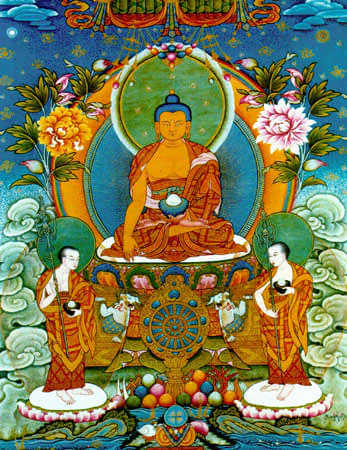
The Sutra on the Benefits and Merits of the Five Spiritual Trainings
I bow to the Noble Three Jewels!
Thus have I heard.
The Blessed One was staying in the country of Barga, in Seysaka Grove, in Deer Park. At that time, in the early morning, the Blessed One donned his monastic robes, took his alms bowl, and set out for the home of the householder Nakulapita. Upon arriving there, he took his seat on the seat that had been prepared.
Then the householder Nakulapita and the householder’s wife Nakulamama went to where the Blessed One was. Upon arriving, they paid homage to the Blessed One and sat down nearby. Sitting there, the householder Nakulapita addressed the Blessed One with these words:
Venerable Blessed One! Ever since this maiden, the householder’s wife Nakulamama, was given to me as a wife in my youth, not once has a thought of adultery toward her ever arisen in my mind. Venerable Sir, since in this present life no physical impurity has arisen between us and we look upon one another, I wish that in future births we might look upon one another in the same way!
Householder Nakulamama also addressed the Blessed One with these words:
Venerable Blessed One! Ever since this young man, the householder Nakulapita, took me as his wife in my youth, not once has a thought of adultery toward him arisen in my mind. Since no physical impurity has arisen between us and we gaze upon one another in this present life, I wish that we may gaze upon one another in future lives as well!
Then the Blessed One said:
Householder and householderess! Since you both share this mutual desire, you look upon one another in this life, and just as surely you will meet one another in future lives!
If two people are equal in faith, equal in morality, equal in generosity, and equal in wisdom, then they find one another in this life and will meet in future lives!
And then he explained the following verse:
When a husband and wife are equal in faith, virtue, and speech, equal in generosity, and live according to the Teaching, speaking pleasant and joyful words to one another—such a husband and wife will attain great wealth and be reborn in a blessed, beautiful realm. Their enemies will be crushed, and thanks to the equal moral character of both, acting in this way in accordance with the Teaching, they will both abide in the purity of virtue. Desiring what is good and rejoicing in it, they will dwell happily in the abode of the gods!
Therefore, one must observe the five precepts. Namely: abstaining from taking life; abstaining from taking what is not given; abstaining from sexual misconduct; abstaining from false speech; and abstaining from intoxicating wine. These five precepts must be safeguarded!
Then the monks also asked for an explanation of the benefits and qualities of the five kinds of discipline:
Venerable Blessed One, how is the ripening of the actions of those who have abstained from killing recognized? How is the ripening of the actions of those who have abstained from stealing recognized? How is the ripening of the actions of those who have abstained from sexual misconduct recognized? How is the ripening of the actions of those who have abstained from false speech recognized? How is the ripening of the actions of those who have abstained from intoxicants recognized?
Then the Blessed One, to clarify the questions they had asked and to give them understanding, spoke thus:
O monks! Killing should be regarded as a poisonous snake. It entails many evils and leads to rebirth in the realm of hungry ghosts, in the animal realm, or in the hells. After the body is destroyed, on the other side of death, such a person is reborn in the hell of Sanjiva. There, the guardians of the hell of Rebirth subject him to complete burning, take up various weapons, cut him into pieces, and pierce holes in his body. They bind him in five ways as they exact this retribution upon him, but this hellish being, dying again and again, comes back to life time and time again—which is precisely why this hell is called “Rebirth” or Sanjiva. They ceaselessly inflict upon him the cruel, harsh, and unbearably scorching torments of the hell of Rebirth, crushing him—and this entire heavy burden is the ripening of the fruit of murder!
Even if such a person [later] is reborn among humans, his life will be short. His sense faculties will be deficient. He will have an ugly appearance, a clouded mind, and will dwell in constant fear and constant anger; he will be prone to illness and sorrow. He will be separated from joy, separated from all that is good, and this separation will be long and unceasing.
Therefore, the Blessed One declared:
Five hundred rebirths as a hungry ghost, a fish, a snake, a wild beast, an owl, a buffalo, a dog, or a fox—such is the retribution for taking a life! This is the ripening of the fruit of taking a life.
By refraining from taking a life, a man or woman will, in the future, attain great benefits and qualities, such as the twenty excellent and perfect qualities. The perfection of the body’s major and minor limbs will be revealed. And their bodies will be endowed with strength and vigor. They will be swiftly reborn into a noble lineage. Their limbs will be pure and supple. Their lives will be long and happy. They will be courageous and full of power. Their speech will become noble and exalted. Together with the gods, they will dwell in joy. No one in this world will cause them harm. Noble men will not utter a single unkind word about them. They will not die from evil sorcery or curses. A boundless retinue will gather around them. They will be fully endowed with beautiful skin tone and appearance. They will have few illnesses and sorrows. They will not be deprived of their family hearth. No one else will harbor ill will toward them.
By completely renouncing the taking of life, a man or woman will surely taste these blessed benefits and qualities. They will dwell among the gods and among humans. After the dissolution of the body and death, they will be reborn into a blissful existence, in the higher realms, in the realm of the gods.
Taking what is not given is the appropriation, without permission, of another’s property—whether animate or inanimate—by means of digging under a house, theft, or the like. Appropriating another’s property by deceit for one’s own sustenance—for such persistent retention of what was taken without permission, a person, after the dissolution of the body and death, will be reborn in the Hell of Screams. As for the realm known as “Screams,” there are two [sections] of the Hell of Screams: the Hell of Blazing Screams and the Hell of Smoldering Screams. In the Hell of Blazing Screams, beings suffer for the duration of one cosmic eon. It is completely filled from within with raging fire. In the Hell of Smoldering Screams, suffocating smoke billows. In both of these places, flames blaze, and hellish beings are boiled in these screams. Fire bursts forth from their nine bodily orifices, burning their bodies. Such is the Hell of Smoldering Screams. In the Hell of Smoldering Screams, the hellish beings are boiled. Smoke billows from their nine orifices. Their bodies are boiled just as food is boiled. One after another, these beings utter loud groans and cries. There they experience fierce, cruel, and unbearably hot torments.
O monks! The act of taking what is not given should be regarded as a poisonous snake. It casts one into the hells, casts one into the realm of the hungry ghosts, and leads to rebirth in the animal realm. The karmic fruit of theft is exceedingly great!
Even if such a person is reborn among humans, his wealth and possessions will be completely destroyed, and not even the slightest thing will remain in the hands of this being prone to theft. It will be extremely difficult for him to find food, drink, clothing, a place to sleep, and so on; he will constantly experience excruciating pain and endure the hatred and oppression of others. Whatever he may find will be lost immediately. Others will take possession of his property. The prosperity he desires will remain out of his reach. His existing possessions will not increase. He will find himself completely cut off from happiness.
Therefore, the Blessed One declared:
To dwell here in destitution, poverty, and scarcity; to have an ugly appearance and endure constant oppression; to be born into the lowest and most despised social classes—such is the vice of appropriating what has not been given! Such is the ripening of the fruits of theft.
Through the complete renunciation of taking what is not given, a man or woman will, in the future, attain great fruits and virtues—twenty excellent and perfect qualities: they will always possess an abundance of grain and be endowed with boundless and flawless wealth. Their wealth, previously unseen, will multiply rapidly, and all their wholesome worldly desires will be steadfast and unshakable. Forms, sounds, tastes, smells, and all that is perceptible will bring them deep delight. To achieve any goals they set, all their thoughts and aspirations will be fulfilled without delay. No kings, bandits, thieves, or ill-wishers will be able to take away what they have accumulated; neither evil people nor raging torrents will ever cause them any harm. Possessing such perfect and enduring wealth, whether they bestow it or enjoy it themselves, the word “scarcity” will never pass their lips. They will abide in happiness and peace without fail. By refraining from theft, a man or woman will surely attain these blessed fruits, which are found among the gods and among humans. After the dissolution of the body and death, they are reborn into a blessed state, in the higher realms and the realm of the gods.
Those who commit adultery in this world, after the dissolution of the body and death, are cast down and reborn in the hell of the Great Wails. From there, on either side of the impassable river, rises the Shalmali Grove, eighty yojanas high. Sharp thorns, sixteen fingers long, hang downward from its branches. The bodies are twelve gyangdrak long, and these bodies are engulfed in flames shooting upward. The flames rise sixty yojanas high; there they ceaselessly kill one another with various weapons and climb these trees in the Shalmali Grove. For many thousands of years, they have been scaling these steel thorns. Moreover, the guardians of hell, seizing their weapons, strike them, causing them to fall headfirst, weeping. And when they fall, they crash directly onto red-hot iron stakes driven into the ground. These stakes pierce them through and out through their anuses, causing them to endure monstrous suffering. Weeping incessantly, they languish for an entire kalpa in iron cauldrons sixty yojanas in size. The guardians of hell forcibly pour red-hot coals into their mouths, filling these vessels to the brim.
Therefore, the Blessed One declared:
Black mountains rise, smooth and lofty. And there stand trees, entirely covered with thorns. Because of these sharpest iron thorns, people from this world know not a moment’s peace there. What good is it now to have a wife remaining in the world of the living, when you yourself are locked atop this dreadful tree?!
Therefore, the Blessed One said:
O monks! Adultery should be regarded as a poisonous snake. It casts one down into hell, casts one down into the realm of hungry ghosts, and leads to rebirth in the animal realm. The karmic fruit of adultery is exceedingly great! Even if such a person is reborn among humans, he will suffer immensely.
Therefore, the Blessed One declared:
To be reborn as a woman for five hundred consecutive births, then as a eunuch for the same number of births, and to be reborn again and again afflicted with loathsome leprosy—such is the retribution for adultery!
Throughout many lifetimes, he will endure oppression, make many enemies, and be forced to live constantly among ill-wishers. When he lies down or stands up, excruciating pain will accompany him; he will be perpetually angry, suffer harm from others, and his body will remain perpetually hunched over. From one life to the next, he will be born deaf, blind from birth, and so on. His appearance will be invariably hideous, his mind will remain in perpetual despondency; he will find joy in constant quarrels and will be completely cut off from a peaceful state of mind. After the dissolution of the body and death, he will be cast down and reborn in the hell of the Great Cries. And there he will endure fierce, cruel, and unbearably scorching torments—such is the ripening of the fruits of adultery.
Through complete renunciation of adultery, a man or woman will, in the future, attain great benefits and virtues—twenty excellent and perfect qualities: such a person will have no enemies, and the whole world will regard him or her with joy. It will be easy for them to find food and drink, as well as clothing, a bed, and a home. They will fall asleep peacefully and sit peacefully, and will awaken from sleep with a calm heart. They will be completely free from fear of misfortune, will know neither deep sorrow nor terror, and no physical illness will afflict them. He will never be born a eunuch or an [unfortunate] woman. Whatever small goal he sets out to achieve, all his desires will be fully fulfilled. He will have many loyal friends, and no one will harbor ill will toward him. All his senses will be perfect, and he himself will be endowed with the true marks of virtue. He will know neither intolerance nor doubt; husband and wife will have complete trust in one another. By refraining from adultery, a man or woman will surely taste these blessed fruits both among the gods and among humans. After the dissolution of the body and death, they will be reborn into a blissful state, in the higher realms, in the realm of the gods.
Therefore, a man who strives for a good [rebirth], life after life, again and again, must not covet other men’s wives. A woman who shows no respect to her father-in-law and mother-in-law, who does not serve her husband and holds him in no regard, who does not bow before her husband’s older brother and causes harm to her husband’s sisters, and who also refuses to work with her hands, feet, and back; does not provide the desired food and drink; knows no shame or conscience toward them; scolds her husband and slanders him—such a woman will be reborn in hell.
There, she is laid on red-hot iron plates; a burning iron hook is thrust into her mouth, and—just as one does with a fish caught on a hook—the tip of her tongue is pulled outward, tied with ropes, and dragged outside. Blows from weapons rain down on the tip of her tongue that has been pulled out, and enormous worms—born directly from her lips—bite into the places where she is struck. Because of these worms devouring her, she is unable to utter a single word. Thus she will be boiled there for many thousands of years. And once boiled, she will once again be cast down into the great hell.
Therefore, the Blessed One said:
A woman who aspires to a good rebirth, life after life, again and again—just as the god and goddess are faithful to one another—must never abandon her husband!
Because of speaking falsehoods, a person is reborn in the Hell of the Black Threads. There, the guardians of hell let out deafening screams, take up various blazing weapons, and drag the hellish beings across the scorching iron ground, hauling them one after another. They strike them with red-hot black threads [marking their bodies], brandish flaming weapons above them, completely cut them apart, and chop them with axes and hatchets, as if sawing logs into tiny splinters. The hellish beings utter terrifying screams and weep incessantly. There they drink their own blood and languish within—this hell is called “Black Threads,” and they are reborn there precisely because of lies. There they endure fierce, cruel, and unbearably scorching torments.
O monks! Speaking a lie should be regarded as a poisonous snake—keep this in mind! A lie gives rise to a great multitude of sufferings. It casts one into hells, casts one into the realm of hungry ghosts, and leads to rebirth in the animal realm. The consequences of a lie are exceedingly grave!
Even if such a person is reborn among humans, he will be devoid of compassion; his voice will be like the cawing of a crow; his tongue will be stiff; his teeth will be infested with worms; a foul odor will emanate from his mouth; and his teeth themselves will be crooked and uneven. His speech will be coarse, his voice hoarse, his lips deformed; he himself will dwell in eternal envy and ceaseless craving. After the dissolution of the body and death, he will invariably be reborn in the hell of the Black Threads.
Therefore, the Blessed One said:
A putrid stench of manure will emanate from his mouth, and this stench will spread for an entire yojana around him. Such a person will never come to know the holy Teaching—such is the consequence of uttering false speech! Such is the ripening of the fruits of falsehood. By completely refraining from speaking falsehood, a man or woman will, in the future, attain great benefits and qualities—thirty-three excellent qualities: their eyes, ears, nose, tongue, body, and likewise their mind—all will become perfectly pure, like the flawless core of a lotus flower. Their eyes and teeth will be even and beautiful; their bodies will be neither too long nor too short, neither excessively fat nor excessively thin. Exquisitely spoken words will flow from their lips. Like the fragrance of the utpala flower, a subtle scent of the kunda flower will eternally waft from their mouths. All servants and subjects will show them deep respect, heeding their words worthy of reverence. They will be well-versed in all teachings and will skillfully understand the meaning, essence, and significance of every sign. In their mental reflections, they will know neither despondency nor timidity, and their speech will be consistently lofty and sublime. By refraining from speaking falsehoods, a man or woman will surely taste these blessed fruits upon being born among the gods or humans. After the dissolution of the body and death, they will be reborn in a blessed state, in the realm of the gods and the higher realms.
So-called “lies” are always accompanied by wrongdoing and flaws. A noble son should under no circumstances resort to them for the sake of achieving selfish worldly goals. On the contrary, one should accept only that which is true, good, and pure nectar [of speech]. So-called “lies” completely deprive a person of true goodness. They deceive the world. And because of them, in the future, a person will suffer for many lifetimes in the deepest hell of Silence (Avici).
Therefore, even for the sake of preserving one’s own life, one should not utter false speech. When the all-knowing Buddha was a bodhisattva and was subject to veils of delusion, slander did not linger within him for long, being like a fleeting mustard flower. Just as a stake driven into a pile of straw will not stand for long, or just as a round fruit cannot remain on the back of a galloping horse—when a person’s head is severed by a sword for a word spoken, he will not utter falsehoods [two different words]. By constantly speaking the truth, the Shramanas and Brahmins lead [living beings] to the other shore of liberation.
Those who drink wine are cast down and reborn in the Hell of Fire (Tapana). Once there, the hellish beings are boiled for many thousands of years. Then they are pulled out and thrown onto the banks of a bottomless and impassable river. Unable to flee anywhere, they drown in it time and time again. There, the guardians of hell, like fishermen pulling fish from a hook, hurl them onto the scorching iron ground. And as they do so, they cry out: “Hey, man, what do you desire?” He replies, “O master, I am thirsty!” Then the guards of Hell use red-hot, fiery iron tongs to pry open his mouth and pour liquid molten metal into it. This metal completely burns his lips. It burns his throat. It burns his chest. It burns his insides. It burns the very heart, and then pours out through the anus. Thus they endure monstrous suffering, weeping incessantly and rolling on the ground. But even at that moment, death does not come to them; until the fruits of their harmful actions are completely exhausted, they are doomed to experience this agonizing ripening [of their deeds] time and time again.
Therefore, the Blessed One declared:
A turbulent and unbearably hot current flows; this bottomless river is extremely difficult to cross. There, iron lotus petals tower, and they roll along these razor-sharp blades. In this bottomless river, devoid of any support, how can those who have not transgressed the Dharma possibly find their way?!
Whoever consumes alcohol commits a grave and pernicious act... Even if he is reborn among humans, he will be perpetually forgetful, foolish, and tongue-tied, like a ram, with a clouded mind, incapable of comprehending the sciences; he will constantly fall into drowsiness; his mind will be meager, his ignorance profound; he will dwell in ceaseless fear, terror, doubt, and suspicion. He will become a slanderer; his words will be untrustworthy; he will turn into a miser and an envious person; he will prove incapable of spiritual liberation, will lose all sense of shame and conscience, his mind will be insignificant, and he will never comprehend the noble teachings.
Five hundred consecutive births as a yakṣa, five hundred births as a dog, and endless rebirths as a madman—such is the consequence of drinking intoxicating wine! Such is the fruit of consuming intoxicating beverages.
Through complete abstinence from alcohol, a man or woman will, in the future, attain great benefits and qualities—thirty-six excellent and perfect qualities: everything pertaining to the past, present, and future, even in the smallest details, they will comprehend with great swiftness. Their awareness and memory will be unshakable; they will never lose their minds and will be endowed with sublime, outstanding wisdom. They will be free from delusion, become vigilant, and their speech will be exceptionally clear and articulate. They will possess a sense of shame; their words will be pure, and they will never resort to false fabrications. They will have no inclination toward slander or coarse speech, nor will they praise the meaningless in vain. And equally, day and night, they will clearly be aware of and feel everything they have done. They will become generous without attachment to material things, abide in pure morality, be free from anger, and their speech will be straightforward. They will be fearless and thoroughly skilled and wise, perfectly endowed with modesty and propriety. They will know neither fear nor anxious doubts. Their minds will be sharp; they will firmly retain what they have heard and become wise mentors to many people.
By completely abstaining from intoxicating drinks, a man or woman will surely experience all these blessed benefits and qualities, both among the gods and among humans.
After the dissolution of the body and death, they will be reborn to a blissful fate, in the higher realms, in the realm of the gods.
These moral precepts must be upheld! Any beings—men or women—who do not observe this morality and do not meditate on it will, after the dissolution of the body and death, fall into evil realms, miserable worlds, and ruinous rebirths. But those who uphold this morality and contemplate it unceasingly will, after the dissolution of the body and death, be reborn in a favorable state, in the higher realms, and in the realm of the gods!
When the Blessed One had spoken these words, those monks praised what the Blessed One had said.
Thus ends the sutra explaining the benefits and qualities of the five moral precepts.
[This sutra] was translated, collated, and definitively authorized from the words of the great pandita Anandashri by the erudite lotsa, the Shakya monk Nyima Gyaltsen Palzanpo, at the great monastery of Pal Tharpa Ling, the residence of those who speak in two languages.
May it shine upon the earth like the Sun and the Moon!
Translated by Lama Dondrub Dorje Tulku.