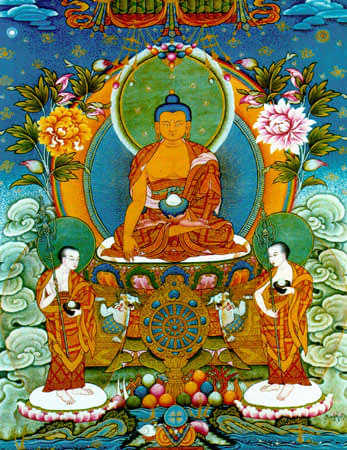
giri-ānanda-sūtra
Sutra of Ananda from the Mountain
I bow to the Noble Three Jewels!
Thus have I heard.
The Blessed One was staying in Sravasti, in Jeta’s Grove, in Anathapindada’s Park. At that time and at that hour, the Venerable Giri-Ananda was afflicted with a severe illness and was suffering. Then the Venerable Ananda went to where the Blessed One was staying. Upon arriving, he paid homage to the Blessed One and sat down nearby. Sitting there, the Venerable Ananda addressed the Blessed One with these words:
The Venerable Giri-Ananda is afflicted with a serious illness and is suffering greatly. Venerable One, I ask the Blessed One to perform an act of kindness. Out of compassion, please go to where the monk, the Venerable Giri-Ananda, is!
Then the Blessed One said to the Venerable Ananda:
Ananda, go yourself to the monk Giri-Ananda and explain these ten reflections to him. Explain them where this sentient being [the monk] resides. And then, as soon as the monk Giri-Ananda hears about these ten reflections, his diseased sense organs and parts of the body will be healed immediately.
What, then, are these ten? They are: reflection on impermanence; reflection on the absence of a “self”; reflection on the impurity [of the body]; reflection on obstacles; reflection on renunciation; reflection on the absence of desire; contemplation of cessation; contemplation of the absence of joy in all worlds; contemplation of the impermanence of all samskaras; contemplation with mindfulness of the inhalation and exhalation.
What is contemplation of impermanence? It means, Ananda, that a monk goes to a secluded place—under the shade of a tree or into an empty house—and there deeply realizes the following: form is impermanent, sensations are impermanent, perceptions are impermanent, mental formations are impermanent, and consciousness is impermanent. Thus should he see these five aggregates of clinging as impermanent. Show him, then, the contemplation of impermanence!
Ananda, what is contemplation of the absence of “self”? This means, Ananda, that a monk goes to a secluded place, under the shade of a tree or into an empty house, and there deeply realizes the following: the eye is devoid of “self,” forms are devoid of “self”; the ear is devoid of “self,” sounds are devoid of “self”; the nose is devoid of “self,” smells are devoid of “self”; the tongue is devoid of “self,” tastes are devoid of “self”; the body is devoid of “self,” tactile sensations are devoid of “self”; the mind is devoid of “self,” mental factors are devoid of “self.” Thus, these six internal and six external sense spheres are devoid of any “self.” This is how one should contemplate and reflect on the absence of self. Ananda, show him this absence of “self”!
Ananda, the contemplation of impurity consists in a monk examining this very body in detail, from the crown of the head to the soles of the feet, including everything contained within the skin, as being full of various impurities. This body contains: hair on the head, body hair, nails, teeth, skin, flesh, tendons, bones, bone marrow, kidneys, heart, spleen, lungs, large intestine, stomach, small intestine, mesentery, bladder, feces, bile, phlegm, pus, blood, sweat, fat, tears, sebum, saliva, nasal mucus, blood-tinged fluid, urine, and the brain—a total of thirty-two impure substances. Thus, one should regard this body as impure. Ananda, explain these [types] of impurity to him!
Ananda, what is the contemplation of hindrances? It means that a monk goes to a secluded place, under the shade of a tree or into an empty house, and there reflects in detail: “This body is full of suffering; it harbors many hindrances, and numerous kinds of illnesses arise in this body. Namely: eye diseases, ear diseases, nose diseases, tongue diseases, bodily ailments, headaches, inner ear diseases, mouth diseases, dental diseases, cough, shortness of breath (asthma), runny nose, acute fever, stomach ailments, fainting spells, paralysis of one side of the body, piercing pains, hiccups, leprosy, tumors, fine rashes, tuberculosis (a chronic disease), epilepsy, ringworm, itching, scabies, rash, eczema, hemorrhagic disorders (diseases of the blood and bile), diabetes, aching limbs, ulcers, inguinal fistulas, disorders of bile, disorders of phlegm, disorders of wind, diseases arising from the combination of the three doshas, indigestion caused by eating at the wrong time, diseases resulting from a decline in vitality, diseases caused by poisoning, diseases arising as the ripening of past actions, chills, fever, intense hunger, thirst, diarrhea, and dropsy. These physical ailments should be regarded as obstacles, and one should meditate on them, Ananda; explain this as the contemplation of obstacles!
Ananda, what is the contemplation of letting go? It means that when a monk has thoughts arising from sensual desire, he does not indulge in them but lets them go. Thoughts arising from the desire to harm or destroy, and thoughts foreign to the practice of contemplation—all that which arises from unwholesome thoughts—he does not hold onto, but completely rejects. He crushes them, does not indulge them, does not nurture them; he does not hold on to the harmful, unwholesome qualities that arise again and again, but completely rejects them. He crushes them, does not indulge them, does not nurture them. Ananda, this is what is meant by the contemplation of abandonment!
Ananda, what is contemplation of freedom from craving? It means, Ananda, that a monk goes to a secluded place—under the shade of a tree or into an empty house—and there deeply realizes the following: “This is peace; this is supreme bliss, where all samskaras cease, where [repeated] births and changes cease, where thirst is quenched, where cessation and nirvana are attained.” Ananda, this is what is meant by contemplation of cessation!
Ananda, what is the contemplation of the absence of joy in all worlds? It means, Ananda, that a monk completely abandons all worldly stratagems, clinging, mental constructs, attachments, and hidden inclinations, and no longer finds any joy in them. Ananda, this should be explained as the contemplation that one does not take delight in anything worldly!
Ananda, what is the contemplation of the impermanence of all samskaras? It means, Ananda, that a monk is free from attachment to all conditioned phenomena, renounces them, and feels aversion toward them. Ananda, this is to be explained as the contemplation of the impermanence of all samskaras.
Ananda, how is mindfulness of breathing [practiced]? This means, Ananda, that a monk goes to a secluded place, under the shade of a tree or into an empty house, sits down there with his legs crossed, straightens his body, directs his gaze straight ahead, and remains mindful.
Then, as he exhales briefly, he knows with certainty, thinking, “I am exhaling briefly.” Whether inhaling deeply or briefly, he knows with certainty, thinking, “I am inhaling.” As he exhales slowly, he knows for certain, thinking, “I am exhaling slowly.” As he exhales briefly or very briefly, he knows for certain, thinking, “I am exhaling briefly.” When the breath is short or a short inhalation and exhalation occurs, he observes it and knows for certain. Then, as he exhales briefly, he knows with certainty, thinking, “I am exhaling briefly.” Whether inhaling deeply or briefly, he knows with certainty, thinking, “I am inhaling.” As he exhales slowly, he knows for certain, thinking, “I am exhaling slowly.” As he exhales briefly or very briefly, he knows for certain, thinking, “I am exhaling briefly.” When the breath is short or a short inhalation and exhalation occurs, he observes it and knows for certain. Seeing both [processes] and having completely calmed bodily activity, he exhales briefly, remaining in this state and practicing. Seeing both [processes], he learns to remain, contemplating bodily activity. Truly experiencing delight (joy), he learns [to be mindful of]: “The breath flows briefly.” Truly experiencing delight, he contemplates it and practices. Truly experiencing bliss, he learns to [be mindful of]: “The breath flows in short bursts.” Truly experiencing bliss, he contemplates it and practices. Truly experiencing mental activity, he learns to [be mindful of]: “The breath flows briefly.” Truly experiencing mental activity, he contemplates it and practices. Seeing both [processes] and clearly perceiving mental activity when the breath is short, he learns to [be aware of]: “It is flowing.” Seeing both [processes], he learns to [be aware that]: “Mental activity is completely stilled.” By thoroughly understanding the mind when taking a short breath, he learns to [be aware that]: “The inhalation is taking place.” By thoroughly understanding the mind, he learns to [be aware that]: “It is completely still.” By inspiring the mind with joy as the breath flows briefly, he learns to [be aware that]: “It is flowing.” By inspiring the mind with joy, he learns to [be aware]: “It is completely purified and calmed.” When the mind is at peace (shamatha), if the breath flows briefly, it learns to [be aware of]: “It flows.” When the mind is at peace, it learns to abide in vipassana. When the mind is completely liberated, if the breath flows briefly, it learns to [be aware of]: “It is flowing.” When the mind is completely liberated, it learns to abide in vipassana. Contemplating impermanence, when the breath flows briefly, he learns to [be aware]: “It flows.” Contemplating impermanence, he learns to abide in vipassanā. Contemplating equanimity, when the breath flows briefly, he learns to [be aware]: “It flows.” Contemplating dispassion, he learns to abide in vipassanā. Contemplating cessation, when the breath is short, he learns to [be aware that]: “It flows.” Contemplating cessation, he learns to abide in vipassanā. Contemplating cessation, when the breath flows briefly, he learns to [be mindful of]: “It flows.” Contemplating cessation, he learns to abide in vipassanā. Contemplating complete abandonment, when the breath flows briefly, he learns to [be mindful of]: “It flows.” Contemplating complete relinquishment, he learns to abide in vipassana.
Ananda, this is how one should explain the meditation that focuses on the inhalation and exhalation. And now, Ananda, go to the dwelling of Giri-Ananda and explain these ten reflections to him. For there is no other outcome: as soon as the monk Giri-Ananda hears these ten meditations, all his ailments will cease completely.
Then the Venerable Ananda, heeding the words of the Blessed One, went to the place where the Venerable Giri-Ananda was staying. Upon arriving, he explained these ten reflections in detail to the Venerable Giri-Ananda.
And as soon as the Venerable Giri-Ananda heard these ten contemplations, all his illnesses completely subsided. When all his ailments had subsided, the Venerable Giri-Ananda rose, and from that time on, the Venerable Giri-Ananda never suffered from any illnesses again.
Thus ends the sutra on the Venerable Giri-Ananda.
[This sutra] was translated, collated, and definitively authorized from the teachings of the great pandita Anandashri by the erudite lotsa, the Shakya monk Nyima Gyaltsen Palzanpo, at the great monastery of Pal Tharpa Ling—the residence of those who speak in two languages.
Translated by Lama Dondrub Dorje Tulku.
