


Library - Tengyur - Comments on tantras
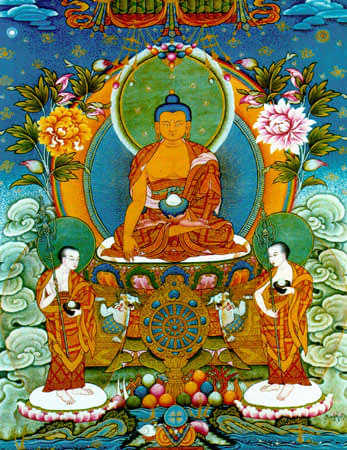
siṁha-nāda-sādhanaṁ
The Practice of Simhanada
I prostrate myself before Simhanada!
First, perform ablutions of the face, etc. Having done so, sit on a comfortable seat. The yogi [must] visualize the syllable a on the disk of the Sun within his own heart. Through this, the guru, the Enlightened One, and others are invited [into the space] before you. When you have done this, perform repentance for harmful actions and so on.
Then make [everything] immediately empty and perform the blessing. When you have done this, perform the prayer of good wishes and remembrance.
Then, from the syllable āḥ that has appeared, the syllable hūṁ [appears]. When it is formed, the Moon [appears]. Upon it [appears] the syllable oṁ. When it is formed, a red lotus [appears]. Above it [appears] the syllable āḥ. When it is formed, a white lion [appears]. Above it arises the syllable hrīḥ. From it [arises] the holy Simhanada. He is white in color, with two arms, a side-swept [hair] bun, and a diadem. He possesses three eyes, holds the attributes of an ascetic, and dwells in the posture of a playful great king. In his left hand, a lotus rises upward, with a blazing sword atop it. In his right hand, he holds a white trident entwined by the hood of a white serpent. To his left stands a white kapala skull, completely filled with various sweet-smelling flowers. Akshobhya resides atop his head. He is illuminated by the five Tathāgatas. It appears as the body of the great nirmanakaya. Meditate thus.
Mantra to recite:
oṁ āḥ hrīḥ siṁha nāda hūṁ phaṭ
This is the Simhanada practice. Translated by Monk Tshultrim Gyaltsen.
Translated by Lama Dondrub Dorje Tulku.