


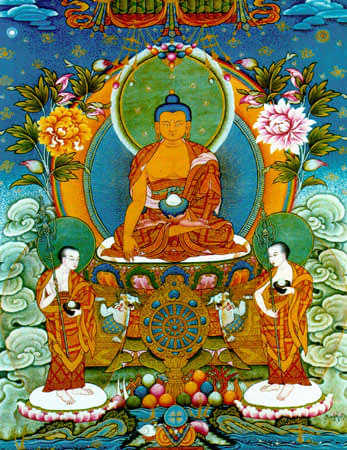
anityatā-sūtra
The Sutra on the Nature of Impermanence
I prostrate before all Enlightened Ones and Bodhisattvas!
Thus I heard on one occasion.
The Blessed One was staying in Anathapindada’s pleasant park, the Jeta Grove in Shravasti. Then the Blessed One spoke as follows to the monks:
Monks! All compounded things are impermanent, unstable, unfit to serve as a foundation for the mind, and possess the nature of total changeability.
Monks! Readily turn the mind away from all compounded things!
Monks! [Act] until there is no passion, no attachment, and complete liberation is attained!
In any case, death is the end for all living things—whether they be sentient beings, elements, or living entities. Ultimately, they will die. Having been born, they cannot avoid death.
In any case, death is the end for all living beings—whether they belong to the family of a householder, a Brahmin, or a king—even those who are wealthy and possess great luxuries, abundant jewels, pearls, lapis lazuli, "shankhashila", coral, gold, silver, and vast riches; who have stockpiles of grain, gold, storehouses, and treasuries; who enjoy sustenance such as bitter beverages, herbs, curds, and yogurt; and who have numerous friends, close associates, and relatives. Having been born, they cannot escape death.
In any case, death is the end for all living beings—such as kings consecrated in the royal lineage, who rule the land, wield power, and stand as victors within the mandala of a vast realm. Ultimately, they will die; having been born, they cannot escape death.
In any case, death is the end for all living beings—such as the "rishis" who subsist on herbs and fruits growing in the forests, living off the produce of the fields. Having been born, they cannot escape death.
In any case, death is the end for all living beings—such as the gods of the Realm of the Four Great Kings, the gods of the Heaven of the Thirty-Three, and the gods of the heavens of Yama, Tusita, Nirmanarati, and Paranirmitavasavartin. Ultimately, they will die. Having been born, they cannot avoid death.
In any case, death is the end for all living beings—such as the gods of the realm of form who have attained the first "dhyāna" (the "Brahmakāyika", "Brahmapurohita", and "Mahābrahmā" heavens): ultimately, they will die. Having been born, they cannot avoid death.
In any case, death is the end for all living beings—such as the gods who have attained the second "dhyāna" (the "Parītābha", "Apramāṇābha", and "Prabhāsvara" heavens): ultimately, they will die. Having been born, they cannot avoid death.
In any case, death is the end for all living beings, such as the gods who have attained the third dhyana—the gods of the Parittashubha, Apramanashubha, and Shubhakrtsna [heavens]. Ultimately, they will die; having been born, they cannot avoid death.
In any case, death is the end for all living beings, such as the gods who have attained the fourth dhyana—the gods of the Anabhraka, Punyavrddhi, Mahaphala, Asamjnisattva, Avrha, Atapas, Sudarshana, Sudrsha, and Akanishtha [heavens]. Ultimately, they will die; having been born, they cannot avoid death.
In any case, death is the end for all living beings—such as the gods of the formless realm (those associated with the spheres of Infinite Space, Infinite Consciousness, Nothingness, and Neither Perception nor Non-Perception). Ultimately, they will die; having been born, they cannot avoid death.
In any case, even Arhats—who have eradicated defilements, accomplished all tasks, done what was necessary, laid down the burden, attained their own goal, completely exhausted the bonds of existence, fully liberated the mind through right understanding, and reached the other shore of holiness regarding all mental faculties—possess the quality of casting off the body, which is pleasing to the mind.
In any case, even the Pratyekabuddhas—who resemble the rhinoceros, act in purity, have subdued the self alone, fully pacified their essence, and brought that essence to perfect Nirvana—even they possess the quality of casting off the body, which is pleasing to the mind.
In any case, even the Tathagata—the Arhat, the Truly Perfect Enlightened One, who possesses the ten powers and the four kinds of fearlessness, who is supreme as the ultimate leader, who unites stability and strength in a body free from craving, and who proclaims the truth with a lion’s roar—even he possesses the quality of casting off the body, which is pleasing to the mind.
Monks! It is just so. A potter makes vessels. Yet they all break—whether he sets them aside for safekeeping or not—and in the end, they perish.
Monks! In the same way, the culmination of the existence of all living beings, of all elements, and of all life is death. In the end, they die. Having been born, they cannot avoid dying.
The Blessed One said:
After the Sugata had spoken thus, other teachers also spoke of this matter.
How wondrous! All compounded things are impermanent; they possess the nature of arising and ceasing. Having arisen, they perish. Therefore, happiness lies in perfect peace. When such [thoughts] flare up with great intensity, how can one act with joy? How can the mind find satisfaction? It is like entering and dwelling in darkness—for in such a state, one cannot find a lamp!
The Blessed One spoke thus. The monks rejoiced and praised the words of the Blessed One.
Thus concludes the Sutra on Impermanence. Translated by Lama Dondrub Dorje Tulku.